October 10, 2026
Paper Room Divider vs. Traditional Folding Screen
Compare paper room dividers with traditional folding screens for weight, flexibility, storage, privacy, durability, and cost.
- Comparison
- Paper Room Dividers
- Room Divider Guide
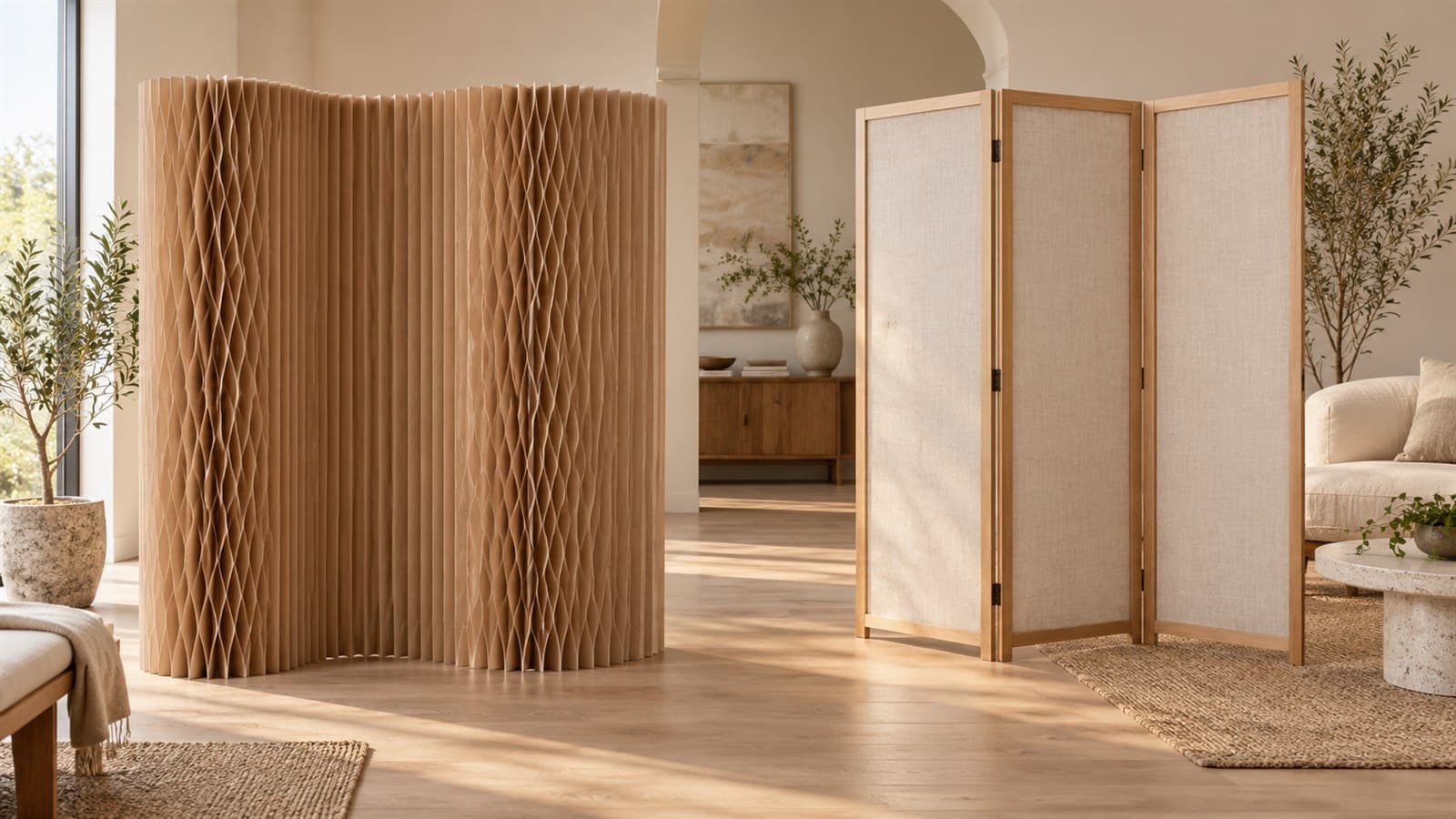
Paper room dividers and traditional folding screens solve the same basic problem: they divide a space without building a permanent wall. Their construction, weight, storage footprint, and visual character are different, so the better choice depends on how the space is used.
What is a foldable paper room divider?
A foldable paper divider uses an expandable honeycomb or accordion structure. It opens to create a straight or curved partition and compresses into a narrow form for storage. Because the structure forms many connected folds, it can often be shaped into an arc, wave, or partial enclosure without hinges between rigid panels.
What is a traditional folding screen?
A traditional screen usually consists of several rigid panels connected by hinges. The frame may be made from wood, metal, plastic, fabric, or composite material. It normally stands in a zigzag arrangement and folds panel by panel.
Side-by-side comparison
| Factor | Foldable paper divider | Traditional folding screen |
|---|---|---|
| Weight | Generally lightweight and easier to reposition | Often heavier because of frames and hinges |
| Storage | Compresses into a narrow accordion stack | Folds to the combined thickness of its rigid panels |
| Shape | Can form straight, curved, wave, or angled layouts | Usually forms straight or zigzag panel layouts |
| Installation | Freestanding and typically requires no drilling | Usually freestanding; some models use feet or wall hardware |
| Surface feel | Textured, architectural, and contemporary | Varies from decorative wood to fabric or printed panels |
| Moisture resistance | Best kept dry and away from wet cleaning | Depends on frame and panel material |
When a paper divider works best
Choose a paper divider when the layout changes frequently, storage space is limited, or one person needs to reposition the screen. It is especially useful for temporary home offices, salon stations, exhibition spaces, retail displays, photo backgrounds, and event zoning.
The continuous folded structure also creates a softer visual line than a rigid panel screen. That can be useful when you want to guide movement or create a semi-enclosed area without making the layout feel permanent.
When a traditional screen works best
A framed folding screen may be a better fit when the divider will stay in one place, when a particular decorative frame is central to the room, or when the environment requires a material that tolerates frequent wet cleaning. A heavier screen can also feel more familiar in a formal interior.
Privacy and sound
Both choices primarily provide visual privacy. Neither should be treated as a soundproof wall. Height, side gaps, floor clearance, and the distance between people all affect perceived privacy. For sound control, add absorptive furnishings or purpose-built acoustic products.
Durability and care
A paper divider should be used indoors, kept dry, and handled by its supported edges rather than pulled sharply from one point. Avoid placing it near open flames or high heat. Traditional screens have different care requirements: fabric can collect dust, wood may scratch, and hinges may loosen over time. Review the product instructions before cleaning either type.
Which option should you choose?
Choose the format that matches the work the divider must perform:
- Pick a foldable paper divider for flexible layouts, lightweight handling, compact storage, and sculptural shapes.
- Pick a traditional folding screen for a rigid-panel appearance, heavier placement, or material-specific cleaning needs.
Use our room divider buying guide to compare size and privacy requirements. You can also browse available GMCY dividers or contact us about a custom room divider solution.